It’s not about more books, it’s the right lens
I hovered over the “Buy” button at 11:47 p.m., suitcase open, ten browser tabs stacked with “Top 50 travel books” lists, and a flight in eight days. The cart looked impressive—four memoirs, a doorstop history, a glossy photo book—but my reading time looked like a joke. I closed the tab and scribbled one question on a sticky note: “What am I trying to notice when I land?”
More books rarely make a trip sharper; they just widen the blur. A tight, well-matched lens does the opposite: it tells you what details to prioritize when you’re tired, slightly lost, and deciding between the third “authentic” market on your route or a quiet neighborhood café. A memoir can tune your ear for social cues, but it won’t save you from outdated logistics; a guide can keep you efficient, but it can flatten the why behind what you’re seeing. The trade-off is real: depth versus practicality, voice versus verification.
For a 10–14 day break with limited pre-trip reading, the goal is coverage, not completion. Pick one book that teaches context (how people organize daily life), one that calibrates expectations (what’s actually hard or crowded), and keep a lightweight, updatable source for current hours and closures. If you’re the type who pins only a few must-dos, this approach works; if you need a minute-by-minute plan, you’ll want something more tactical than most “must-read” lists admit.
Pick your travel-book mood first
The problem showed up at checkout: two paperbacks in my cart, one audiobook queued, and a red “arrives after your departure” banner on the only guide I actually needed. I stared at the delivery date like it was a moral failing. With eight nights left and a commute that barely covers two chapters, the question wasn’t “best book,” it was “what mood am I reading for?”
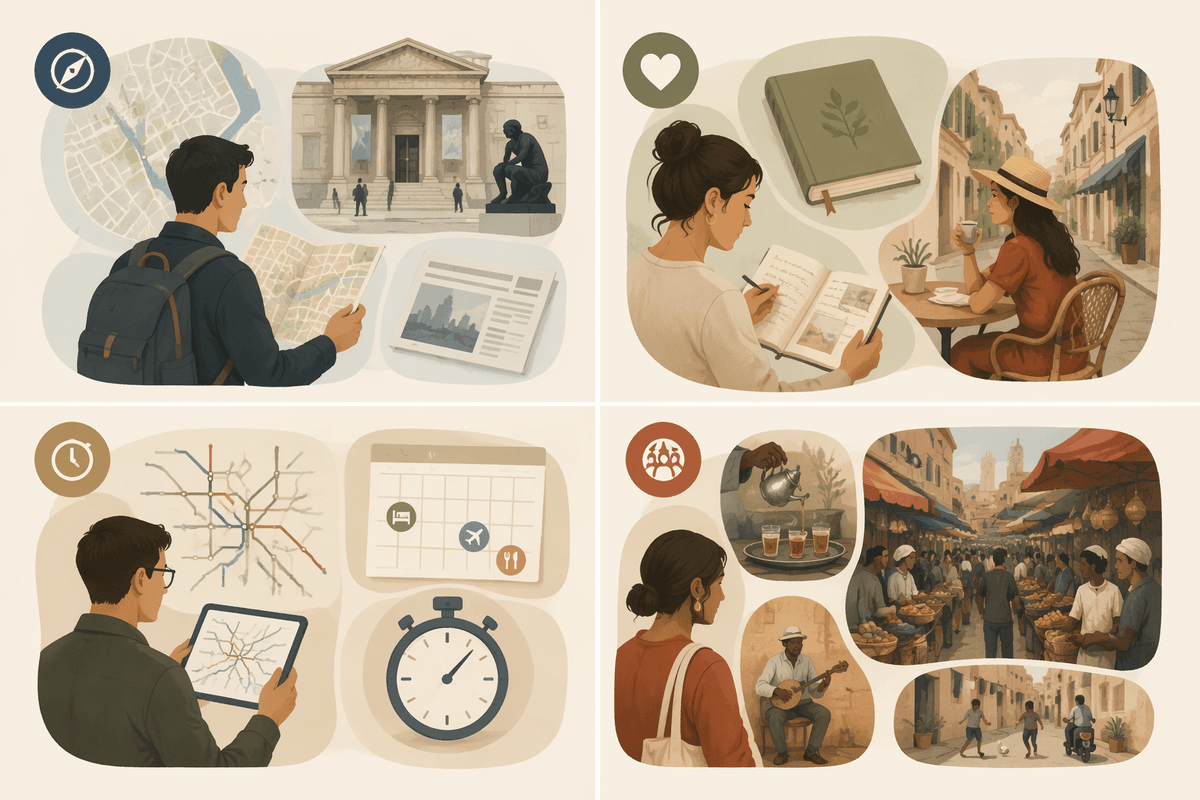
If you pick the mood first, the stack stops fighting itself. “Orientation” books (short histories, city essays, tightly argued journalism) work when you want a mental map—power, class, religion, money—before you start interpreting street life. They’re great for museums and neighborhoods; they’re weak on timing, prices, and what’s closed on Mondays. “Intimacy” books (memoirs, diaries, novels with strong place-sense) help you hear what locals might mean, not just what they say, but they can also romanticize inconvenience and make you expect serendipity on demand.
Then there’s “efficiency” versus “immersion.” A practical guide, a curated Google map, or a few recent longform pieces are blunt instruments for crowd flow, reservation windows, and transit friction—perfect if you hate wasting daylight. The trade-off is they rarely explain why a ritual matters or why a neighborhood feels tense. Decide which frustration you’re trying to avoid this trip—confusion, shallowness, or wasted hours—and let that mood choose the first book.
Books that sharpen on-the-ground awareness
At 7:18 a.m., I paused at a corner that looked straightforward on my saved map—two streets, one café pin, done—but the sidewalk was a river and the crosswalk cycle felt stingy. A couple in workout gear glided through like it was normal; I stood there counting gaps, suddenly aware I didn’t understand the local rhythm yet. The map was accurate, but it wasn’t legible.
The books that sharpen on-the-ground awareness aren’t the ones that list sights; they teach you what to pay attention to when you’re moving. Short social histories, neighborhood essays, and tightly reported journalism do this well because they explain the “rules of the room”: who uses public space, how queues form (or don’t), what politeness looks like under time pressure. Their limitation is timing—great for interpretation, weak for “do I need a reservation on Tuesdays?”—so they work best paired with something updateable.
What I reach for, especially when I’m tired and making slightly lazy decisions, are books that train small senses: food writing that explains daily schedules, architecture or transit narratives that make you notice why routes feel inefficient, even slim language/etiquette guides that cover gestures and soft don’ts. Compared to a memoir, they’re less romantic; compared to a guidebook, they’re less precise. If you can only commit to one, pick the kind that matches your likely failure mode—getting socially clueless, or getting herded with the crowds.
Stories that set expectations realistically

I started a chapter in a beachy novel at 10:06 p.m., thinking it would “put me in the place,” and realized by page twelve the characters had infinite afternoons and zero logistics. Meanwhile my own day had been a scramble of timed-entry tickets, a missed lunch window, and the kind of museum line that moves in slow, insultingly polite inches. The story was beautiful; it was also lying to my calendar.
The most useful “expectations” stories are the ones that admit friction: crowds that peak at predictable hours, neighborhoods that feel farther than they look, and social norms that only make sense once you’re hungry or damp or late. Compared to an orientation book, they give you fewer frameworks but better emotional accuracy—what a long commute does to your patience, how a famous viewpoint can feel oddly transactional at noon. Their limitation is specificity: even honest narratives age fast on prices, reservation rules, and which cafés got TikTok-famous last month.
I look for writers who describe trade-offs out loud: the postcard alley that’s worth it at 8 a.m. but miserable at 1 p.m.; the “local” restaurant that’s great if you can wait, pointless if you’re guarding limited daylight. These books work for mid-budget travelers who plan loosely and want fewer naive pins; they’re less helpful if you need a precise sequence. If you finish one and feel slightly sobered, keep it—it’s probably doing its job.
My short list for any itinerary
The night before a Monday flight, I tried to squeeze four “essential” books into a carry-on already arguing with a rain jacket and a second pair of shoes. One was 600 pages and still had a library sticker on it—optimism, not planning. With my phone at 12% and a 6:10 a.m. alarm set, I deleted the fantasy stack and kept only what could actually survive a tired commute and a crowded afternoon.
My short list stays boring on purpose: one compact orientation read (a city essay, brief history, or reported book) that explains how the place works—power, money, religion, class—because that’s what keeps you from mistaking “pretty” for “important.” It’s weak on closures and ticket windows, so I treat it like context, not instructions. Then I add one friction-honest narrative (memoir, travel writing, or even a novel with logistical humility) to set expectations about pace, weather, and crowd flow; it’s emotional calibration, not accuracy.
The third slot is strictly updateable: saved pins plus one current source for hours, strikes, and timed-entry rules, because nothing ages faster than “walk right in.” If you’re traveling with limited reading time, this stack works; if you want to improvise everything, keep just the narrative and accept a few wasted loops. When I’m unsure, I pick the book that will change how I notice a street, not the one that promises to “cover” the city.